

On June 19, 2025 — Juneteenth — Maryland Governor Wes Moore made a landmark announcement that would put his state on the vanguard of efforts to reverse generations of discrimination.
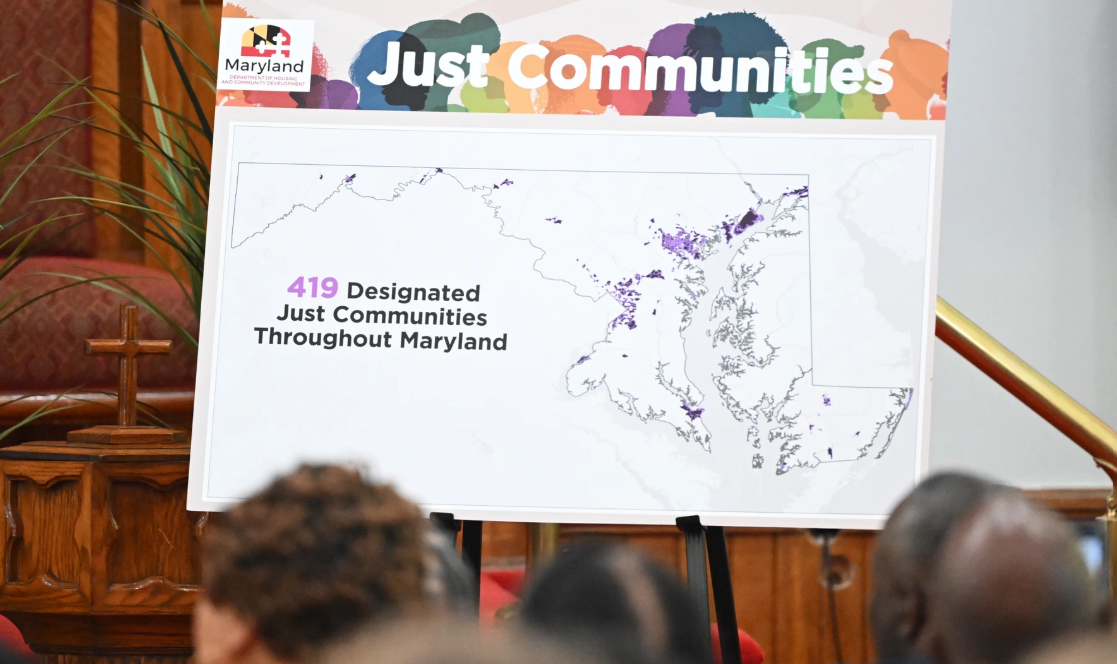
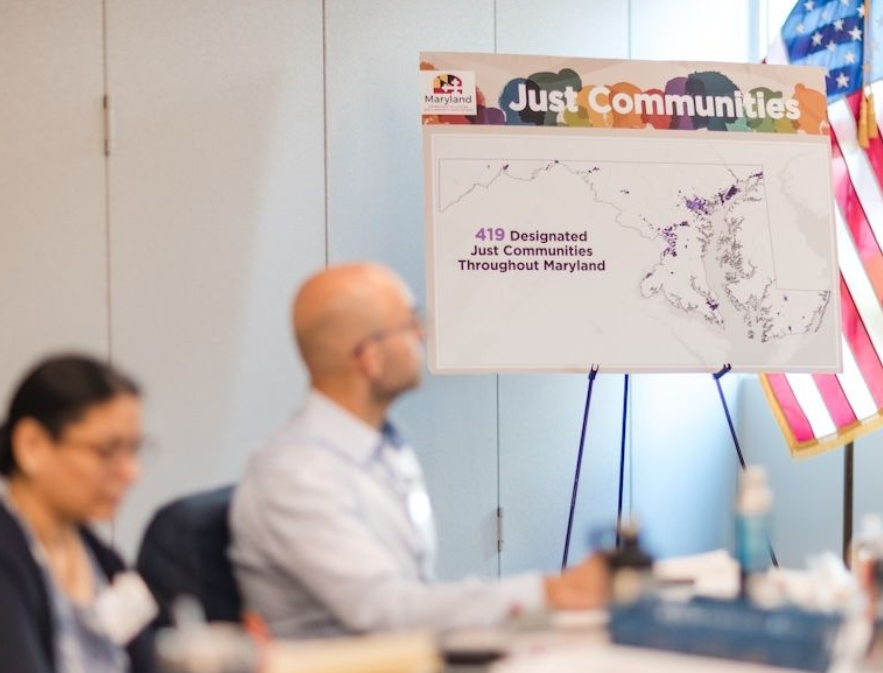
Moore declared 419 individual geographic areas within the state eligible for increased state investment. These “Just Communities” range from large sections of Baltimore and the Washington, D.C., suburbs to rural cities and small towns in the mountains and near the Chesapeake and Atlantic coasts. What they generally have in common: Persistent burdens around housing, health, wealth and environmental factors, atop a history of segregation, displacement and disinvestment.
Moore’s initiative is not the first time a state has attempted to redress past injustices. California, Illinois, and New York, among others, have targeted certain funds toward disadvantaged communities. But Just Communities is arguably the most sweeping effort of its kind. The strategy is written into state law, not just policy. It’s aimed at redirecting wide swathes of state funding, not just specific funding streams. And it’s grounded in rigorous data analysis.
“The work of repair involves all communities, and it’s going to take us looking at every corner of Maryland to get this right,” Moore said from the pulpit of Bethel AME Church in Cambridge, a city of about 13,000 in Maryland’s rural Eastern Shore — a portion of which was designated a Just Community. “This is one of the most aggressive initiatives in our state’s history to address our racial wealth gap. Because the work of repair is not in the future. The work to repair is now.”
As Maryland leaders implement this vision, they are learning lessons state and local governments across the country can benefit from. Maryland is working in new ways to change how existing public resources are allocated, coordinate investments across agencies, draw in new partners and funds and evaluate whether those investments are improving peoples’ lives. Addressing disinvestment in small cities and rural communities, in addition to larger urban areas, is a big part of the thinking. As Cat Goughnour, who leads the rollout for the Maryland Department of Housing and Community Development (DHCD), puts it, “What is most groundbreaking is that this is a policy-backed structural-transformation approach to equity and justice.”
Grounding changes in data
Critical to the Maryland initiative is connecting historical discrimination to current conditions on the ground. The state Legislature laid the groundwork by passing the Just Communities Act in 2024. The two-and-a-half page law stated a need to “right the wrongs of the past” and called for a data-driven approach to prioritizing funding in ways that “increase racial, economic, and health equity in the state.”
Goughnour’s first step was to produce a baseline report documenting how redlining, exclusionary zoning, urban renewal and other discriminatory policies produced racial and ethnic disparities in wealth, life expectancy, housing stability and neighborhood investment in urban, suburban and rural areas. Next, she commissioned a geospatial data analysis yielding the 419 Census tracts designated as Just Communities in Moore’s Juneteenth speech.
Authoritative public data were available for nine of the 14 factors referenced in the state law. Those include housing-related data on homeownership, housing cost burden, residential vacancy and historical discrimination in home lending. Rates of asthma and lead exposure, as well as proximity to federal Superfund sites, are indicators of health and environmental risks. Incarceration rates underline an area's social and economic challenges. The idea, Goughnour says, is to “use data of past policy decisions to target areas that we know have been disproportionately affected and then shift how public investment is being allocated to address the outcomes.”
The next step was to begin tying this analysis to state funding decisions. There’s no separate pot of money for Just Communities. Rather, the aim is to give Just Communities a leg up on millions of dollars’ worth of competitive grants and other funding. Essentially, funding applications from local governments or nonprofits based in or serving Just Communities get bonus points in the scoring.
Programs within the DHCD were the first to pilot the approach. It’s early days, but there are signs that healthy sums of state support are flowing into Just Communities. For example, 60 percent of the $70 million awarded in a recent round of revitalization grants went to Just Communities. Similar patterns are unfolding in small business lending, grants aimed at alleviating food deserts and counseling programs aimed at helping residents prepare to buy homes or avoid foreclosure.
An early lesson is that it takes more than bonus points on grant applications to make sure that funding reaches Just Communities. Local leaders often don’t know about state grant opportunities, especially in small and rural cities. Sometimes, they also don’t trust that they would have a real shot at the money. Outreach is critical.
“We’re really aware that one of the natural outcomes of harm that has been caused to communities is a disconnect between government and the community and whether or not we are making sure they’re aware of resources available to them,” says Danielle Meister, Assistant Secretary of the DHCD’s Division of Homeless Solutions.
Meister says housing assistance programs are doubling down on outreach through community associations and knocking doors to make sure residents know about services available. “We’re really focused on how we take services to the people who live in Just Communities and flip the history of experience with the government on its head.”
Over the next year, these efforts will expand into what Governor Moore calls an “all of government” approach. A growing number of state agencies will begin prioritizing Just Communities in their competitive grantmaking and lending. Goughnour also plans to launch a cross-departmental trauma-informed community development “core team” to catalyze collaboration, coordination and learning.
Another goal of bringing departments together: growing resources for small cities and rural areas to tackle local problems by braiding other state and federal resources. These linkages are already happening. For example, in one rural community with substandard water and sewer connections, environmental and housing officials are teaming up to simultaneously address the infrastructure challenge as well as underlying “tangled title” issues that can make it difficult for homeowners to access support. As Aneca Atkinson, Assistant Secretary of Environmental Justice with the Maryland Department of the Environment, puts it: “We all can play a part, and do play a part, in rectifying these issues.”
Meanwhile, local governments are likely to use the state’s Just Communities designations to satisfy a new requirement to include an equity component in their comprehensive plans. That’s a significant change for local governments across the state, says Joe Griffiths, Director of Planning Best Practices with the state Department of Planning. “One way local governments can meet the new requirement is by talking about how they are going to intentionally engage with those communities or target investments on everything from capital investment to green space to transit connections.”
People are the focus
While shifting funds is a key goal in Maryland, Goughnour also wants to change how government leaders engage with neighborhoods where there is a history of systemic injustice. Her term for this approach is “people-centered placemaking,” and it’s a big part of the Just Communities agenda.
Part of it is acknowledging that government decisions have caused lasting harm, and changing how agencies work with communities to not repeat or compound that harm. In March, the DHCD’s Division of Just Communities and the Public Finance Institute (formerly The Public Finance Initiative) hosted a two-day cross-agency capacity-building workshop. They developed strategies and tools for better understanding residents’ concerns and priorities, in part through exercises aimed at building empathy for the challenges faced by people with low incomes.
Goughnour later built on that interagency training with another focused on trauma-informed community development. Staff from more than a dozen agencies came. “It was a very structured process that allowed people to think about self, society and the system,” Goughnour says. “We need to think about how our organizations, agencies and institutions show up in the community, or have shown up in the past, if we’re thinking about righting the wrongs.”
The idea is to move away from an orientation where the state imposes solutions on communities, and instead sees the residents as experts to problem-solve with. Goughnour says that will become especially important if Just Communities succeeds at its goal of stabilizing neighborhoods. If not, the risk then would be triggering a wave of gentrification that forces residents out.
“The old theory of investment is ‘if we build it they will come,’” Goughnour says. People-centered placemaking is different. “This thinking is, ‘If they’re already here, how does investment ensure that residents can stay and sustain themselves in their communities, rather than being swept away by market forces?’”
Robust evaluation is another feature distinguishing Just Communities. Goughnour is currently rolling out an evaluation framework to assess results of the overall initiative, starting with the first full year of implementation within the Maryland DHCD. The initial focus is on making sure that funding is reaching Just Communities as intended and generating insights that can help agencies learn and iterate.
Over time, Maryland will be measuring outcomes such as changes in wealth and life expectancy, community stability and other long-term indicators. The map of which Census tracts are designated Just Communities will be updated every five years to ensure that resources continue flowing to places that need investment the most. The hope is that some current Just Communities will not qualify next time because outcomes will have improved for the people who’ve long lived there.
“The lesson for other states is that place matters — and so does how we show up,” says Jake Day, Maryland’s Secretary of Housing and Community Development. “The first step is admitting that government has not always gotten it right. As state government, it’s our responsibility to acknowledge our faults, rebuild trust and restore hope for communities and our people.”
Acknowledgements & Disclaimer
This resource was created for educational purposes only as part of the Rural & Small Cities Program, with the support of the Robert Wood Johnson Foundation. The views and perspectives presented in this resource are those of the authors and the Public Finance Institute team.