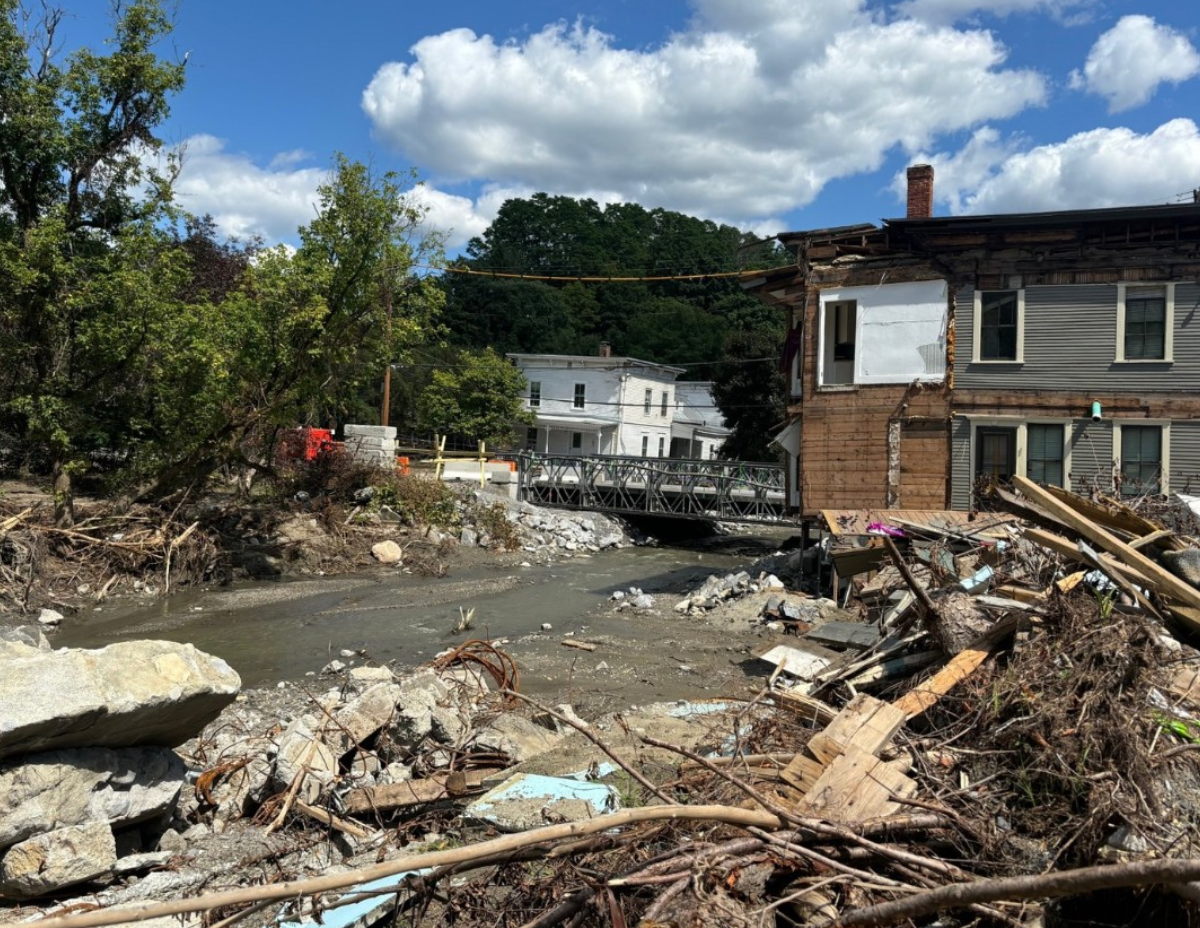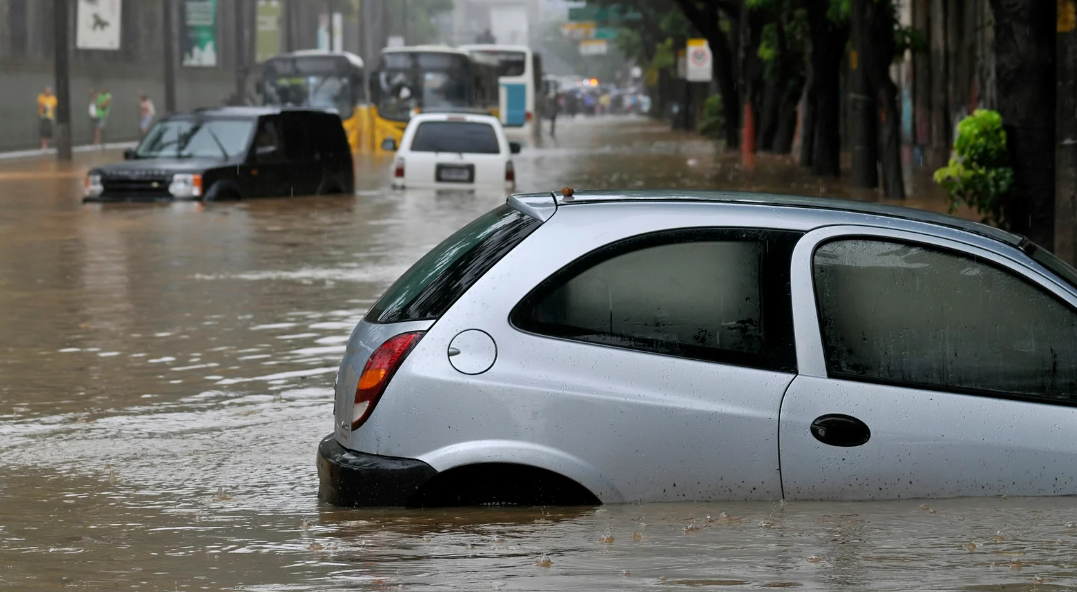


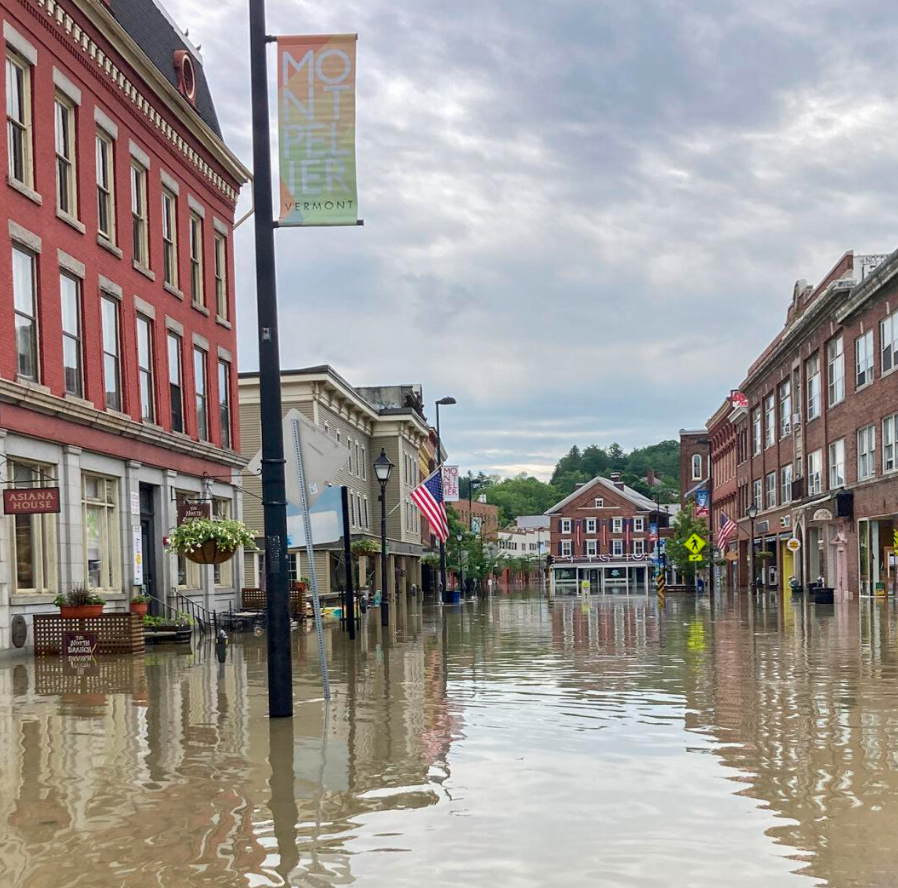
On July 10, 2023, almost eight inches of rain fell on the city of Barre, Vermont. As runoff rushed down hillsides into the river flowing through town, branches and other debris clogged up behind bridges, damming up water that quickly spilled over into neighborhoods. Hundreds of homes in the city of 8,000 were badly damaged in the city’s worst flooding in almost a century.
City leaders knew the cleanup would be expensive. They got right to work anyway, hiring backhoes and dump trucks to haul debris away. The recovery tab rang up to about $3 million — a huge sum for a town with an annual operating budget of about $15 million.
“We were all money out and no money coming in for a few months,” says Carol Dawes, the Barre City treasurer. “We had no idea how much was going to ultimately qualify for reimbursement from FEMA or the state. And yet we had to do it.”
Barre (pronounced like “Barry”) was not alone. Small cities and towns across Vermont got hit hard by the same storm. Fortunately for them, a state entity known as the Vermont Bond Bank partnered with the state Treasurer to offer low-cost loans they could use for cleanup. These loans were a lifeline for local governments waiting on reimbursements. Barre City borrowed $1.5 million and paid it back about a year later once FEMA funds started flowing in.
Epic rain events used to be seen as rare in Vermont. Now, they are widely recognized as a regular feature of climate cange. In fact, exactly one year after the 2023 floods—July 10, 2024—another storm unleashed more floods in Barre and elsewhere across the state. The Bond Bank fired up a new round of recovery loans. In total, the Bank’s upstart Municipal Climate Recovery Fund has lent out $33 million to 27 towns and cities, with more expected as recovery work continues. Thanks to a partnership with the Vermont League of Cities and Towns, many of these loans carried an interest rate of zero percent.
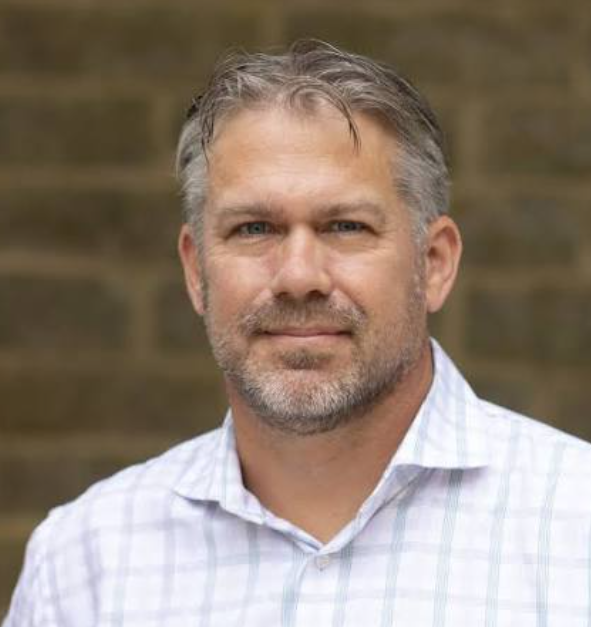
The back-to-back flood events got the Bond Bank’s executive director, Michael Gaughan, thinking about longer-terms solutions.
“We started to take a hard look at the levels of exposure our towns had to these flood hazards,” Gaughan says. “It’s very clear that this is one of the largest credit risks we face as a state.”
Since then, the Vermont Bond Bank has begun developing new tools as part of its participation in a Public Finance Institute (formerly The Public Finance Initiative) program focused on building finance capacity in rural and small cities. The Bank’s goal is to not only help small cities and towns recover from disasters. It’s also to make roads, bridges and other public assets less vulnerable so that the next storm will cause less harm to both infrastructure and local governments’ balance sheets.
Vermont’s experience carries lessons for state and local governments across the country, who are wrestling with a growing number of expensive disasters at a time when federal aid cutbacks raise uncertainty about who will foot the bill. “We clearly need to do something,” Gaughan says. “What we’re thinking about is, ‘How do we provide tools and resources that will give municipalities incentives to do risk-reduction work?’ The vision is to complete the cycle—connecting recovery to rebuilding to resilience.”
Support for small cities
Vermont is the most rural state in the nation. Nearly two out of three of the state’s residents live in areas the U.S. Census Bureau classifies as rural. Vermont’s largest city, Burlington, has just 45,000 people; about 100 of Vermont’s roughly 250 municipalities have populations of less than 1,000. Jurisdictions this small often struggle to find resources to pay for local services or invest in buildings, roads and other long-term capital projects.
To support them, state leaders created the Vermont Bond Bank in 1970. The Bank pools together the borrowing needs of small municipalities and issues bonds on their behalf. This enables towns and small cities to tap capital markets they would be unable to reach on their own. While more than a dozen states have since adopted similar models, Vermont was the first to set it up. At the end of 2025, the Vermont Bond Bank’s signature pooled loan program had about $680 million in loans outstanding to 190 local governments, school districts and other entities.
The Bond Bank’s role gives the institution a unique stake in the fiscal health of Vermont’s local governments. When Gaughan took the helm in 2018, he noticed a worrisome pattern. Many municipalities across the state were still fiscally burdened from flooding six years earlier when the remnants of Hurricane Irene wiped out roads and bridges. The high cost of rebuilding and yearslong delays in federal reimbursements left localities stretched too thin to build back better.
Small jurisdictions faced other hurdles to bolstering their resilience. Some towns have only one or two employees, and get overwhelmed by all the government and insurance paperwork. Other towns are averse to taking on debt. Some common-sense actions can solve one problem but create another. For example, buying out property owners in a flood plain may prevent future flood damage but also worsen local finances by removing property from municipal tax rolls.
Perhaps the biggest hurdle is time. Kathleen Ramsay was town manager in Killington when Irene took out many roads and bridges there. “We had to get those roads open,” says Ramsay, who now works with the Vermont League of Cities and Towns, helping municipalities to develop long-term capital plans. “We didn’t have time to say, ‘oh we should have a 36-inch culvert here.’ We had to use whatever was available at that time to get the road open.”
Incentivizing resilience
To catalyze new approaches, the Public Finance Institute (formerly The Public Finance Initiative) and Bond Bank convened municipal leaders and finance experts in Burlington for a dialogue in December of 2025. City and town officials spoke frankly about shared challenges. And they offered the Vermont Bond Bank feedback on incentives that could encourage local governments to adapt local infrastructure and protect their fiscal health.
A few themes emerged in the discussion. First, municipalities like how the Bank offered recovery loans after the recent floods, and want those to continue. They would welcome new loan products aimed at improving resilience but prefer that participation be voluntary. Second, they wanted to prioritize the Bank’s resilience efforts on transportation infrastructure since roads and bridges make up the vast majority of flood damage they’re seeing and those are not insured. Third, they wanted help with up-front project planning costs, which typically run into the tens of thousands of dollars and can strain small-town budgets. These and other next steps are included in an Action Plan co-published by the Public Finance Institute (formerly The Public Finance Initiative) and the Vermont Bond Bank.
Since then, Bond Bank staff have been moving to implement the recommendations. A first step came in July when the Bank issued a set of budget recommendations to localities. Specifically, the Bank spelled out how much money each municipality should set aside as budget reserves to withstand transportation losses in the next big storm. The promising news: In many cases, cities and towns can substantially improve their fiscal resilience by setting aside less than 1 percent of their budget per year. The Bank also published a white paper laying out the thinking and methodology behind its recommendations.
Next, the Bank is working on developing financial tools communities can use to widen culverts, build bridges to new flood standards, or even decommission roads or bridges that repeatedly take damage. One idea the Bank is preparing to pilot will offer communities low-cost planning loans to undertake the engineering studies necessary to start such projects. Another idea under exploration would be to offer low-cost loans to undertake resilience construction projects.
The hope is “to create some new financial products that enable jurisdictions to withstand future events,” Gaughan says. “And if they do that, they’re going to have fiscal sustainability, civic sustainability, and our portfolio is going to be healthier.”
Moving to higher ground
A vision of what that could look like is already coming together in Barre. Following the 2023 flood, the city decided to move a critical public works garage out of the floodplain. The current garage is a cramped 100-year old building. During the flood, it became inundated with water and mud. City workers had to hustle to move dump trucks, loaders and other equipment out of harm’s way.
Those vehicles are big assets in a small city like Barre. “With the exception of a fire truck, the equipment we buy for the Public Works Department is by far the most expensive,” says Dawes, the treasurer. Last November, Barre voters agreed to borrow $3.3 million through a Bond Bank pooled loan to finance work on a new, more spacious garage at higher elevation. “It will provide more security around the millions of dollars’ worth of equipment we house on this particular campus,” Dawes says.
Barre voters also agreed to borrow $2.4 million through another Bond Bank lending vehicle to help finance a new flood-resilient housing project. Barre had an affordable housing crisis even before flooding destroyed hundreds of homes. The new development will create 31 units of affordable housing on an underused downtown parking lot. The building is designed to elevate living spaces and mechanical equipment to limit any future damages from high water. The bond proceeds will pay for upgrades to water and sewer lines, landscaping and utility work, and will be paid back from new tax revenues expected to be generated in the area.
Like many cities and towns in Vermont’s mountains, there are some things Barre can’t change, Dawes says. The city is just four square miles, with no room to grow out. Most homes and businesses are squeezed into the same areas where the river and streams flow. That doesn’t mean city leaders can’t be strategic about leveraging tools from the Bond Bank and other sources to make their communities and finances less vulnerable. “The lesson for communities, legislators and for state government,” Dawes says, “is that the more tools we can have in our toolbox, the better.”
Acknowledgements & Disclaimer
This resource was created for educational purposes only as part of the Rural & Small Cities Program, with the support of the Robert Wood Johnson Foundation. The views and perspectives presented in this resource are those of the authors and the Public Finance Institute team.